A few years ago, I wrote a teaching case about a recently established marketing department in a large company. The department had been formed by merging three smaller units, and on paper, it looked like a fairly standard restructuring.
But something interesting happened when I used the case in class: My students often pointed out that the new department’s mandate seemed incoherent. It was supposed to both provide advice and services to internal units — and also monitor those same units for compliance with corporate marketing guidelines. In other words, the unit was meant to serve and control at the same time.
That tension stuck with me. If a large, resourceful organization can create a unit with such conflicting expectations, how often does this happen elsewhere? And what would the criteria be for a good mandate?
That question eventually became the seed for a longer research project — and a collaboration with my colleague Shawn Pope. When we turned to the academic literature to ground our work, we were surprised to find almost nothing. The idea of a “unit mandate” is familiar to most managers (everyone I spoke to could articulate their own), yet it has received little attention in organization theory.
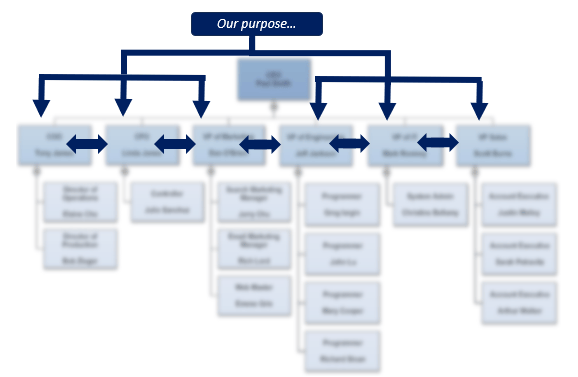
That gap was part of our motivation for the article we just published in Academy of Management Perspectives. In it, we argue that organizations need more than inspiring purpose statements — they also need to align their formal structures with that purpose, through clearly formulated unit mandates.
You can read the abstract of the article here and watch a video where Shawn and I explain the main idea.
And if you’d like a copy of the article itself, feel free to message me.
Related posts:
Embedding the mission and purpose in the design of the organization
Why you need a focused mandate