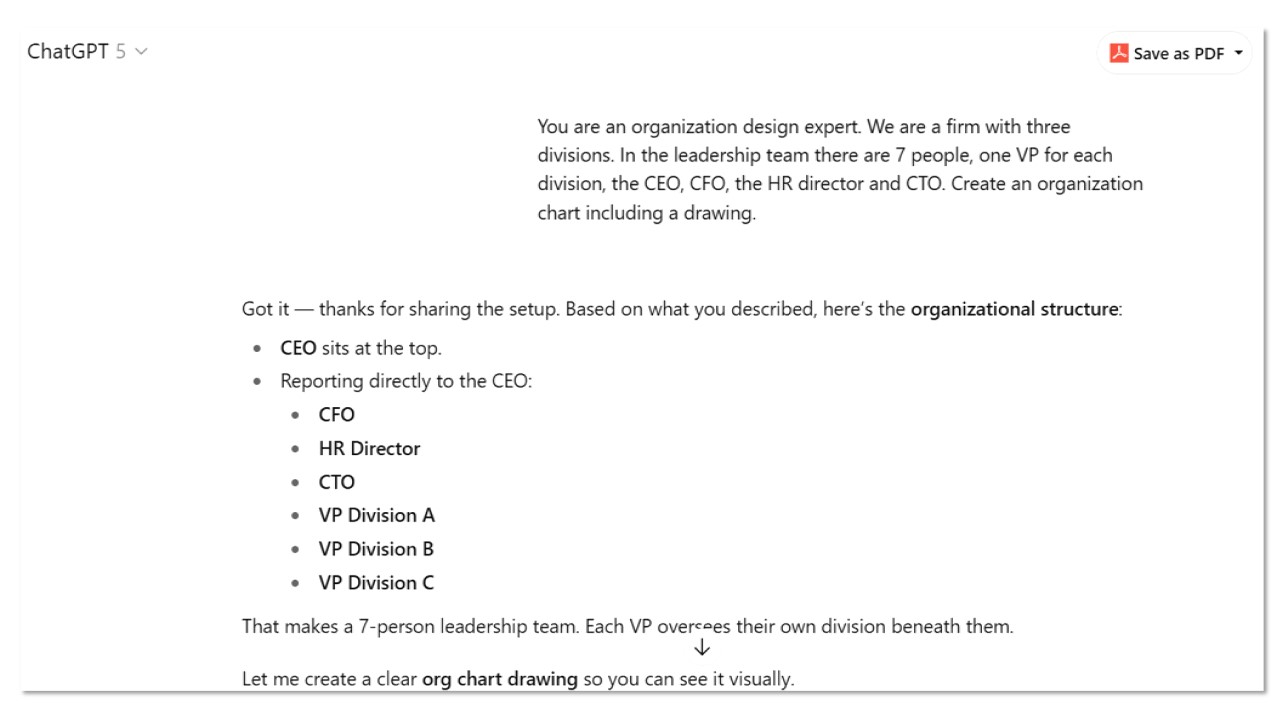
Can you use ChatGPT (or other LLMs) to optimize your organization chart?
This was the question asked earlier this year in an article on Linkedin. It was written by Mike Harmer, the HR director at a U.S. healthcare provider (you can find the article here).
In the article, he provides some examples of how he uses ChatGPT to read hand-drawn organization charts and give advice on potential improvements.
It’s a good article with interesting examples. It is clear that ChatGPT can be a sparring partner in organization re-design projects—in the same way as with most other tasks that we deal with.
Yet there’s currently a big limitation with LLMs that I don’t see much discussion of: They are obviously based on publicly available training data—information scraped from the internet.
Making good organization design decisions, however, relies on having relevant and reliable data from your own organization. In my previous blog posts, I have suggested particular types of data that may be relevant to consider.
The key success factor in organization design is finding a model that works for your firm or institution. The organisational model needs to be tailored to the particular strategies, priorities, business processes, human resources, technologies, and locations of your organization. It goes without saying, then, that making decisions without such data is problematic. You risk selecting an inappropriate organizational model and suffering from a protracted and costly implementation process.
We are working with LLMs that seem to come from another world in terms of sophistication. At the same time, internal data in most organizations are quite primitive.
I am not surprised that data specifically related to organization design may be missing, because re-design processes are relatively infrequent. So we have to collect the required information when we need it; for example, information about unit mandates, interfaces, or time utilization.
Yet even basic data—such as who works in the organization and who they report to—are often missing or riddled with errors.
This is something my colleagues and I have experienced repeatedly while working with clients. To take just one example, we recently examined the employee data of a large public-sector organization in Britain. The client wanted us to upload the data to Reconfig so we could create an organizational “digital twin.”
In the files, we found, among other things:
- Employees in local units who are listed as reporting directly to the managing director of the entire organization, even though we know they actually perform operational roles.
- Employees with circular reporting relationships—meaning they indirectly report to themselves, something which became clear once we tracked the reporting relationships across multiple management layers.
- Employes that report to managers who no longer work for the organization.
It goes without saying that if we don’t have an adequate map of the current organization, it will be hard to re-design it.
There’s also the risk that because it’s so easy to use LLMs, we ignore the more tedious work of collecting, analyzing, and interpreting internal data.
Unfortunately, this exactly what seems to be happening. Here’s how Jules Siegel-Hawley, a consultant, summarized it in a blog article:
AI is rapidly improving our ability to generate the formal artifacts of organizational life:
Team structures, role descriptions, process documentation, even proposed decision flows.
The surface of the organization has never looked more polished…and more disconnected from how the work actually happens.
I don’t mean to say that we shouldn’t use AI. But the most powerful thing is to use AI with your internal data, and to combine that with a participative process where people are involved in analyzing and interpreting the results and evaluating the options that the tool generates.
Related posts:
Creating a digital twin of your organization
What kind of data do you need to re-design your organization?