
Generative AI is not like automation in the past: While automation in the past focused on replacing repetitive tasks, generative AI can perform tasks that require creativity, empathy, and strategic decision making-skills.
In some cases, generative AI becomes like a co-worker. In these cases, we can talk about an “AI agent.” This happens when AI performs a task that was previously done by a human, when team members have a direct interface and can communicate with it, and when it learns and adapts its behavior over time.
Some people compare it to having a remote co-worker on the team.
If so, the question becomes: Should you include the AI agent on your organization chart?
Sounds silly, perhaps, but I think there are two strong reasons that suggest that you should consider it. Both of them have to do with classic principles of management and organization design (in particular, those formulated by Elliot Jaques).
If you include the AI agent on the organization chart, reporting to yourself, it makes clear where the accountability lies.
The AI agent is not just some “IT system” that is floating around somewhere in the organization or run by the IT department: You are accountable for its performance.
This is important at a time when it has become worryingly common for leaders to blame the IT system for errors and failures in their organizations.
Secondly, even though the performance of AI agents can be impressive, they need to be supervised, just like human employees. You should not delegate a task to an AI agent if you are unable to tell whether it produces good or bad outputs.
As Norwegian consultant Erling Gabrielsen put it in a recent comment on Linkedin:
To use and manage advanced technology effectively, we must understand it. Like you cannot effectively employ a junior associate with massive skill sets without possessing skills yourself, the same goes for AI.
The AI agent should report to you and not vice versa, and you need to have the ability to provide guidance to it and evaluate the quality of its outputs.
So this is what we do in Reconfig: We show the AI agent alongside other team members (as in the image below) and the tool specifies its tasks and estimates the productivity gains.
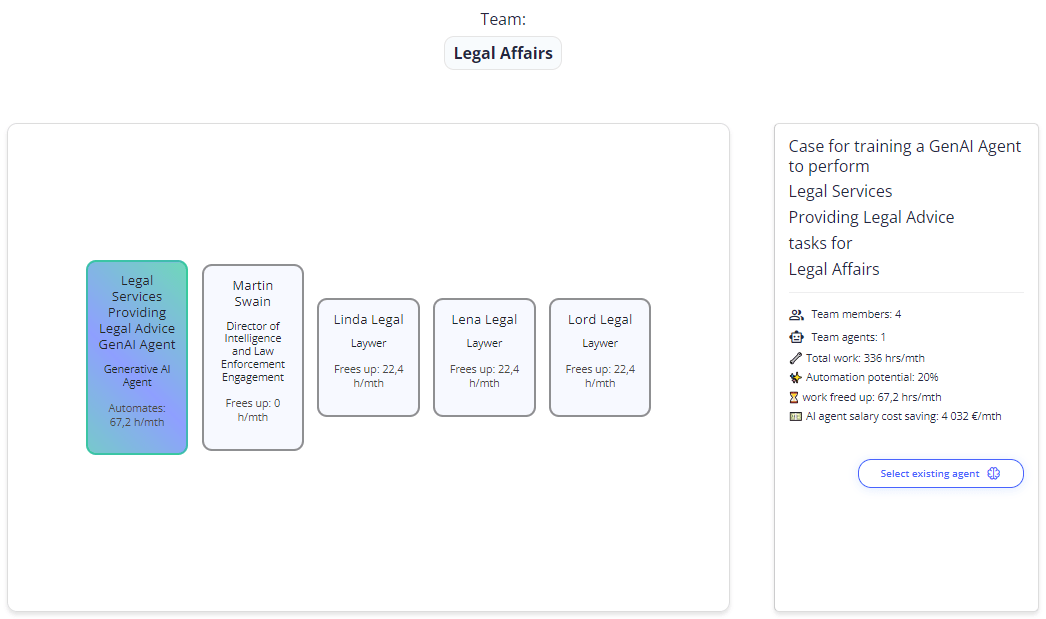
Placing the AI agent on the organization chart isn’t just a gimmick; it’s a symbolic declaration.
It tells everyone in the organization that the buck stops with the leader. You’re not just the manager of people anymore: You’re the manager of intelligent systems as well.
I heartily agree. Now, how do we assess the cognitive capability of an AI agent so that we can make sure that the AI agent’s manager is a full strata more capable and able to add value to the AI agent’s work?
Maybe ask the same question we would with a human?
I’ve been exploring AI agents and various bots. One idea that makes sense for me is to build a series of individual AI agents to do specific roles or work flows order to have appropriate controls. This means to design an AI agent at a Stratum of complexity and evaluating and controlling that AI Agent as one would a human being or team that was fit for that work.
So there could be AI-agents designed for use at each Stratum. Picture a Stratum VI Agent accountable to a Stratum VII CEO.
Yet, this is a temporary fix perhaps as within a few years we will perhaps have the capability of building AI-agents that could run multiple or massive numbers of Stratum VII companies – and we have no way of thinking about that right now.
Your thoughts?
Interesting thought, Ken. I will discuss it with my colleagues.
Nicolay
I just spent 10 minutes asking Perplexity.ai questions and reading responses and then asking deeper questions.
My first question was “Experts in organization design are musing about how AI-agents ought to be considered in designing organization structures and processes. Summarize various perspectives on how this might be done.”
You can see my dialogue at:https://www.perplexity.ai/search/Experts-in-organization-nyAk7il6S7uQLZ6ujY0ThA
Wow!
I would love to see how you might structure such a discussion with Perplexity.ai or your favourite bot and then see your expert comments about its various responses and then commentary on the overall experience.
I would love to read your advice on how org designers might use AI to support their org design work – benefits and cautions.
Perhaps a case study you and your students could do with one of your clients (assuming that you are still doing consulting), that is supplementing your normal org design methods with using bots like Perplexity.ai or others to support your diagnosis and design.
This feels like a rich and important new stage of organization design.
Questions pop up like:
‘Would you put a fully automated, unmanned factory in the chart?’
‘A remotely operated gas-fired power station generating electricity?
I’ve never seen it … and these systems are not that different from AI in the sense that they do work too.
Someone in the chart is held accountable for delivering ‘output’, reports to someone and can be fired …
How do you ‘fire’ your AI when it misbehaves? There must be some human employee acting as the AI-watchdog that can switch it off.
So, I’m not yet convinced that it would make sense now to add AI in the chart while we never thought about that for other unmanned systems.
I like your logic L.J., and agree that the capturing “the work” of AI seems more like how you’d capture value of information, technology, etc. today (just on steroids!) and definitely part of the value stream, yet could also imagine it being listed as a “role.” Where I struggle is seeing it as a job (position, etc.), but am open and curious to explore what Nicolay is proposing. I also like the idea of accountability for AI and having metrics or ways to indicate the value you expect to derive from it, and where in the value stream it shows up.