I have a new article that was published in Journal of Organization Design this week. It is co-authored with a former doctoral student at my university (and now postdoc at ETH and Cambridge), Federico Cammelli.
The topic is role grouping—how roles are allocated to form teams (or, at a higher level, how teams are allocated to form sub-units, such as departments or business units).
When I left the consulting world in 2015 to become a university professor, this was one of the topics I wanted to investigate. I observed that there was a gap between the academic literature on organization design and the work I had done for clients.
In the literature, organization design was sometimes presented as the art of achieving a sufficient level of coordination between two or more units that already exist in an organization.
I am not denying the importance of coordination, of course, but in my client projects, we usually started one step before, by asking: How should the units (e.g., teams or departments) in this organization be designed in the first place? I would argue that this is the key decision in organization design.
But how do people actually make such decisions?
Despite frequent reorganizations in practice—where roles and units are re-shuffled—there was no established method to study how real decision-makers figure out the right grouping.
So this became the goal of our research project. We wanted to systematically study how people perform role grouping by performing an experiment.
I started exploring the idea in 2016. I soon realized I needed help with the research design and statistical analysis. Luckily, Federico came on board in 2018. Together we went through three major iterations of the research design before we found a format that worked.
So it took 9 years to finish this project. I wish we had been able to get the paper published before. But the result, we believe, is a useful new method that others can refine and build on. Throughout these 9 years, hundreds of students that I have taught have participated in different versions of the experiment.
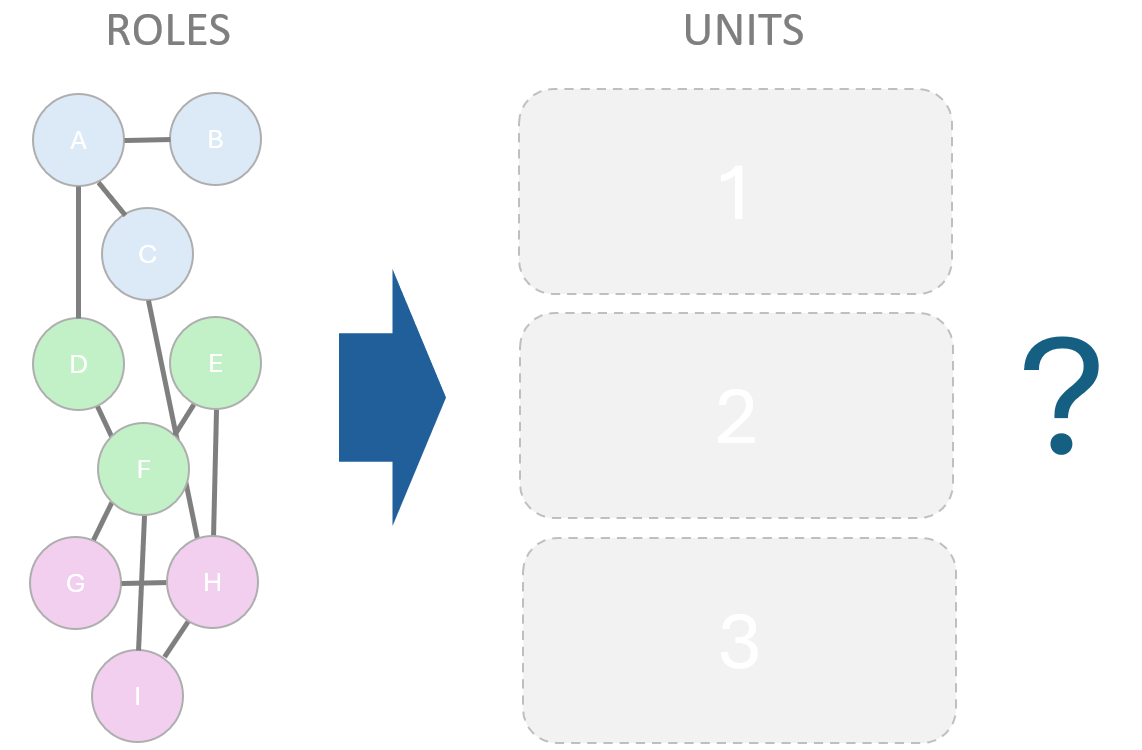
In the article, we propose an experimental method where participants are given a set of roles—each with certain interdependencies—and asked to form teams.
We compare the participants’ solutions to an optimal solution, which is defined as the minimization of coordination costs. To minimize coordination costs, one has to consider the interdependencies between the roles (in the figure above, illustrated by means of the links between the circles [roles]).
So basically what we do is to combine organizational theory with cognitive psychology.
One question we ask is why grouping so difficult to do without software support.
We show that interdependencies can overlap or pull you in conflicting directions. For example, two roles might work closely on one product, while each also needs frequent input from a third or fourth role. You end up having to make trade-offs: place all roles that sometimes collaborate in the same team, or focus on the ones that always collaborate?
Even with as few as nine roles, it turns out that finding an optimal arrangement is surprisingly difficult. Indeed, for the most complex task that we used, only around a third of participants identified the optimal solution.
If that’s happening with nine roles, just imagine how challenging this gets in real life, with 90 or even 900 roles to shuffle.
In the paper, we dissect where exactly people tend to make mistakes—and we demonstrate a systematic approach for studying (and improving) real-world decisions of this type.
You can try yourself to group a more complex set of roles here.
You can read the article here.
Related posts:
William of Baskerville in the library
Should you adopt a mirror image structure?