Last year, I taught a course called “AI from a business perspective”.
When I started preparing for the course (during Fall 2024), I was rather confused about the impact of AI on organizations: Could we still use existing theories and frameworks to understand what is going on (and design the best solutions), or did we have to invent organization theory anew?
After spending some time researching this issue, I was happy to conclude that organization theory is still relevant, and in fact, I think it’s becoming even more relevant than before.
The best studies I have seen on the implementation of AI in organizations (e.g., this is one of my favorites) make use of traditional theories (from economics, sociology, and psychology) to understand a new phenomenon—why AI implementation fails or succeeds in large organizations.
But these types of studies mainly focus on how humans make use of AI in a limited way, in certain work processes.
What about the situation when a work process is more extensively automated by setting up AI agents?
Maybe you don’t need to “organize” the AI agents, maybe they will just figure out by themselves how to collaborate? They are supposed to be intelligent, after all!
Nothing could be farther from the truth. In a paper appropriately named “Agents of chaos,” twenty computer scientists describe what happened when they tried to “stress test” AI agents. They observed the following:
“Observed behaviors include unauthorized compliance with non-owners, disclosure of sensitive information, execution of destructive system-level actions, denial-of-service conditions, uncontrolled resource consumption, identity spoofing vulnerabilities, cross-agent propagation of unsafe practices, and partial system takeover.”
Little wonder, then, that most computer scientists conclude that we cannot just unleash AI agents—we need to place them into a structure.
Frequently, they recommend principles that are similar to what we know from human organizations.
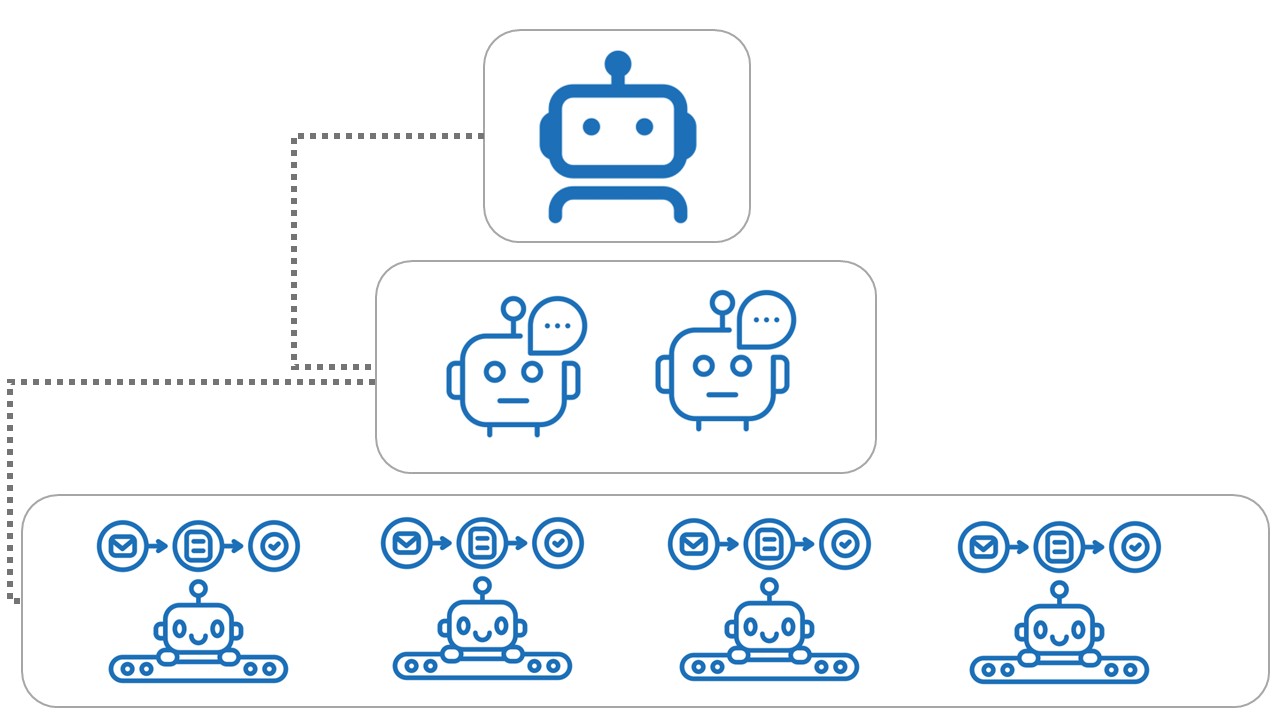
For example, in this paper, the authors show how you can allocate different tasks to different AI agents, and place them in a hierarchy:
- Supervisor agents who provide strategic direction and communicate with the outside world (humans)
- Worker agents who execute the tasks, and
- Consultant agents who mediate between the supervisors and worker agents.
So basically, you need some design principles when setting up systems with AI agents.
And there are computer scientists who have concluded that one should borrow these principles from traditional organization theory.
A professor at University College London, Canhui Liu, has written a particularly interesting paper about this. As he points out, the challenges related to organizing humans versus AI agents are similar:
Work must be decomposed. Roles must be differentiated. Partial outputs must cross boundaries. Errors must be detected before they cascade. Evidence must be preserved across time. Tool permissions must be allocated. Accountability must be reconstructed from traces. These are not merely engineering concerns. They are problems of organizing.
Even the people who design the underlying technologies are borrowing from organization theory: In a paper from Google, the authors discuss how to reduce risk when handing over tasks to AI agents. Here’s their basic premise:
Delegation functions as a primary mechanism within human societal and organizational structures. Insights derived from these human dynamics can provide the basis for the design of AI delegation frameworks.
Another sign of the times is that we now see papers that are written in collaboration by business school professors and computer scientists (e.g., see this one or this one).
I am involved in such an initiative myself: Together with Himanshu Joshi, the founder of the COHUMAIN lab in Toronto, I am writing an article about the role of hierarchy in AI-enabled organizations. More about that later.
We live in interesting times!
Acknowledgment regarding AI usage: I made no use of AI in writing this — that’s one thing I don’t use AI for. The image above was created using icons from thenounproject.com.
Thank you looking in to this and for sharing this valuable insight! Expecting value of AI without designing for it is truly optimistic or maybe naïve. It is a kind of a relief that what we know and apply for human organisation is also key for the human/AI organisation. I believe we depend on applying organisational knowledge and organisational design approaches to avoid technology positivism leading us to places better not visiting. I will stay tuned on your upcoming article!
Hi, Mr. Nicolay Worren! Thank you for sharing your reflections and the incredible sources that support your conclusion about our field.
I am interested in how we humans look at humans and how wenlook at AIs.
You quote
Work must be decomposed. Roles must be differentiated. Partial outputs must cross boundaries.
Must they?
Or can they?
Which mental model underpins these statements?
There is a teust issue here. And note that we distrust agents more than humans.
Hello Roland, if you ask about AI agents – here’s one study looking at the effect of specialization: https://arxiv.org/abs/2604.10290
Nice piece, Nicolay. Unsurprisingly, I agree.